



Discovering the Game Change Project
By Karen Greenough
Just two miles from Caersws, tucked away along a quiet country lane, you’ll find something pretty special: the Game Change Project. Surrounded by fields, streams, and muddy tracks, this fantastic initiative is quietly transforming the lives of young people who struggle to access mainstream education.
In their own words, the Game Change Project provides transformative, skills-based outdoor learning programmes that support young people to build confidence, resilience, and essential life skills. After spending time on site and meeting one of the founding directors, Sian Roberts, it’s easy to see that this is far more than an alternative education setting, it’s a place where young people can reset, reconnect, and rediscover what they’re capable of.
Programmes That Meet Young People Where They Are
The project currently runs two core programmes. The ICan programme is a 12-week course for young people aged 13–16 who face challenges engaging with full-time mainstream education. Alongside this is Achieve, a vocational skills development programme for 14–18 year olds, offering practical, work-based experiences and opportunities to gain vocational qualifications.
Both programmes are designed to equip young people with a toolkit of life skills, things like confidence, teamwork, problem-solving, and communication. Leaving them better prepared for the next stage of their lives.
Young people are referred through schools or parents, and the project runs four days a week. Each day supports two or three small groups of six young people, allowing for plenty of individual attention. Some groups are supported by mentors, young people who have previously completed the programme and returned to support others. It’s a powerful model, and one that clearly works.

Learning by Doing: Land, Mechanics, and Animal Care
Participants choose from three modules based on their interests: Land, Mechanics, and Animal Care. Watching these sessions in action really brings the project to life.
Our visit began in the Mechanics area, where a large covered workshop houses agricultural machinery of all shapes and sizes. Inside, a group of lads were completely absorbed in learning how to remove and refit a set of brakes. Under the guidance of Andrew, and with support from John, a long-standing volunteer, the group worked together, talked through problems, and shared a few laughs along the way.
John explained that when some of these young people first arrived, they had very limited communication skills and were often afraid to speak up for fear of getting something wrong. Watching them now confident, engaged, and chatting freely, you’d never guess that was once the case.
From there, Sian led me through a gate and along a very muddy track beside a stream (thankfully, I’d worn trail running shoes). This was home to the Land group, who were hard at work learning the art of cobbling. Their task for the day was creating a solid floor area for an already impressive den they’d built earlier in the programme.
A couple of lads were wading in the stream hunting for the perfect stones, while another mixed sand and mud ready to “cement” them in place. It looked like hard graft, and I commented that they must go home exhausted. Sian laughed and agreed but added that the physical work improves their sleep and appetite, both essential for good health and wellbeing.
Nearby, two young people were preparing wood shavings to build a fire beneath the den. One of them, P, had previously completed the programme and now returns as a mentor to other youngsters . In his own words: “I just keep coming back.”
The Land group has also built raised beds, donated by Keep Wales Tidy, where vegetables are grown and later cooked as part of the learning experience.


Building Trust Through Animals
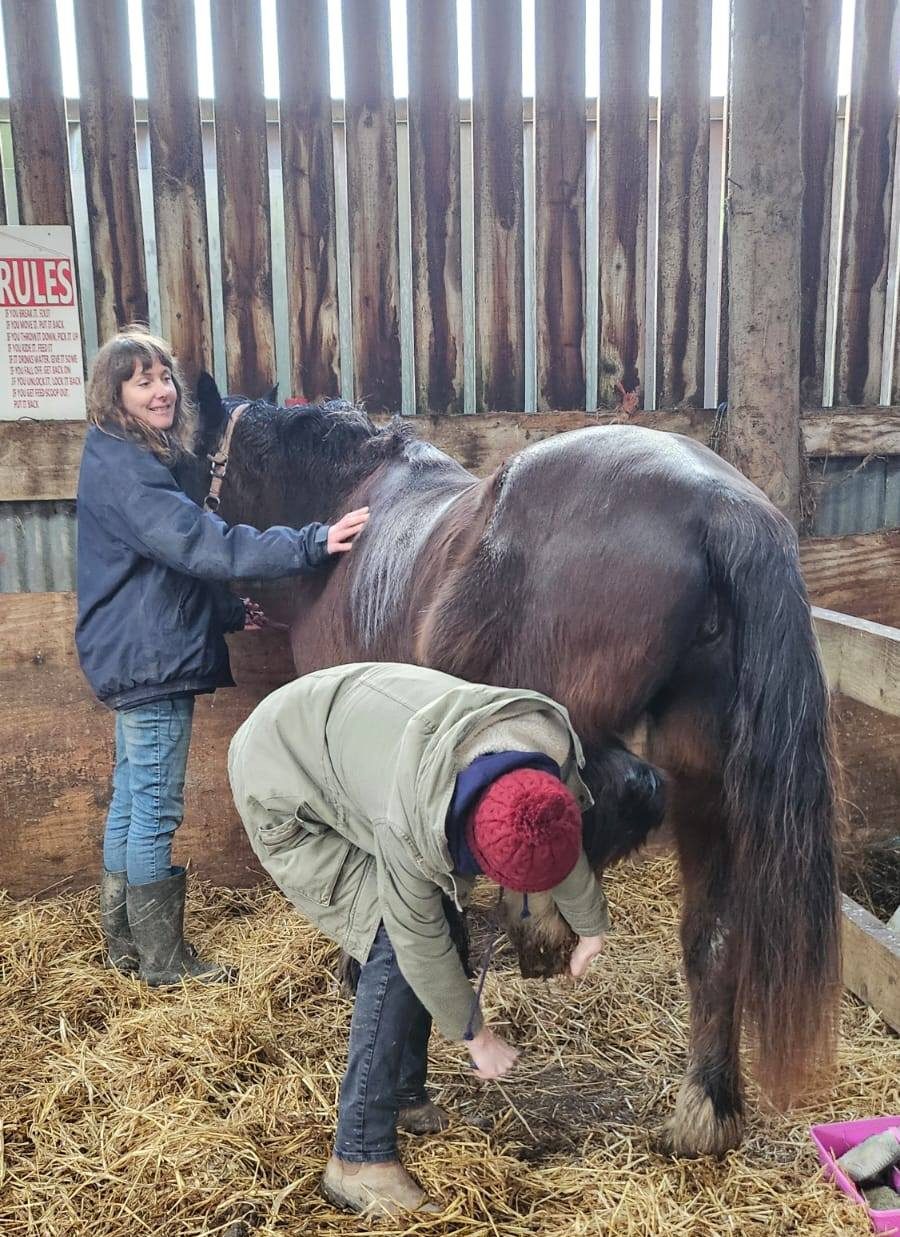
The Animal Care module introduced me to George, Babe, and Wilbur, three Kune Kune cross pigs, one of whom took a particular interest in my shoes. The project is also home to three horses, rabbits, chickens and even a ferret (apparently very effective at coaxing young people out of cars).
Sian explained that some young people arrive terrified of the animals, especially the horses. One girl was so anxious she was visibly shaking at first. Over time, with gentle encouragement and patience, she grew in confidence, eventually riding one of the horses. It’s a perfect example of how small steps can lead to huge personal breakthroughs.

Tracking Progress Beyond the Classroom
Inside the main buildings, young people complete assessments and worksheets, but in a way that feels supportive rather than overwhelming. On arrival, each young person fills in a Life Skills Wheel, scoring themselves on areas such as confidence, communication, teamwork, goal setting, and time management. This is revisited halfway through and again at the end of the programme, giving a clear picture of just how far they’ve come.
They also complete a simple Daily Mood Tracker using emojis to show how they’re feeling when they arrive and when they leave, alongside information about sleep. These tools help staff spot changes in behaviour or wellbeing early and respond appropriately.
A Project That’s Clearly Working
The Game Change Project is currently so well used that there’s a waiting list and after seeing the young people in action, it’s easy to understand why. Success stories include a young man from Llanidloes who went on to start his own landscaping business and now returns to speak with current participants.
The team is keen to welcome teachers onto the site too, so they can see young people thriving in a different environment and gain a new perspective on their abilities.
Get Involved
The Game Change Project is always looking for volunteers, particularly those who can help with fundraising, event organisation, or share skills in Land, Mechanics, or Animal Care. They’re also keen to build relationships with local businesses that could offer visits and real-world experiences for the young people.
To find out more, visit thegamechangeproject.co.uk, follow them on Facebook, or get in touch via their website contact form. Alternatively, you can call them on 07766 606276.